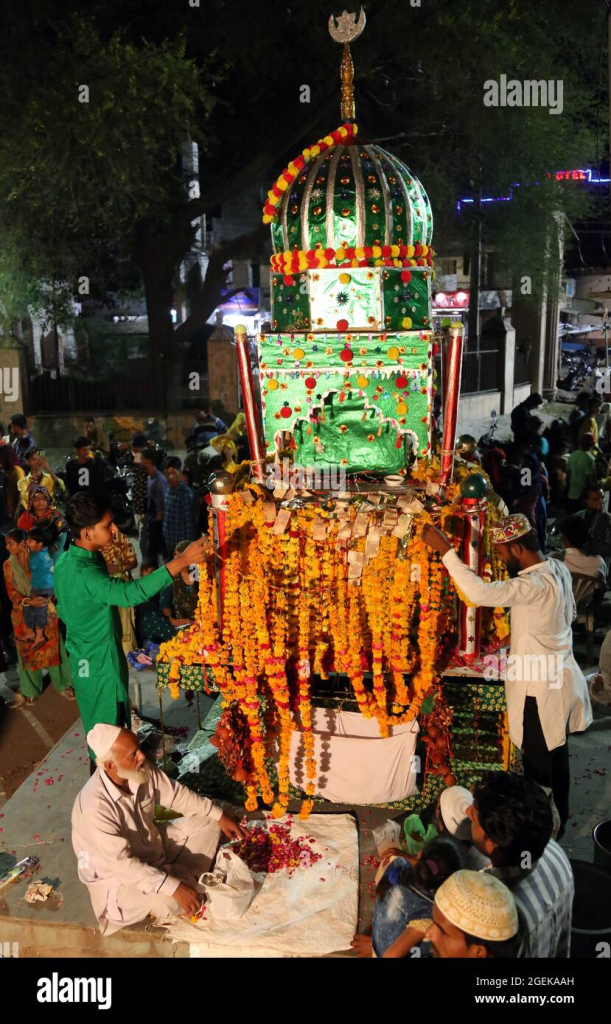
After the death of Caliph Muawiya in 680 CE, his son Yazid ascended to power in a move that many viewed as a deviation from Islamic principles. He demanded that Husayn ibn Ali—Prophet Muhammad’s grandson—pledge allegiance. Husayn refused, asserting that Yazid’s leadership lacked legitimacy, prompting Husayn and his small caravan, including women and children, to leave Mecca in pursuit of safety and support. Though they aimed to reach Kufa, they were intercepted by Yazid’s army and forced to encamp in the barren plains of Karbala by 2 Muharram. Supplies and access to water were deliberately cut off, creating a desperate standoff apkpure.com+3islamans.com+3biseworld.com+3.
🎙️ 2. The Standoff: Denied Access and Moral Resolve
For five agonizing days (2–6 Muharram), Husayn and his companions endured harsh conditions: no water, no shelter, and constant watch. Delegations from Yazid attempted to persuade Husayn into submission, offering worldly incentives. Husayn remained firm, declaring his refusal to lead a corrupted regime. The extreme deprivation served not just as a tactic but as a testament to moral strength before the upcoming confrontation.
⏳ 3. The Seventh of Muharram: Final Diplomatic Efforts
On 7 Muharram, amidst impossible circumstances, Husayn’s camp received another envoy. This time, an intermediary offered water access and safe passage if Husayn would pledge allegiance to Yazid. Husayn’s unwavering response echoed earlier refusals—he preferred certain death or resistance over compromising his principles. Some accounts highlight his speech emphasizing upholding truth, safeguarding the Prophet’s lineage, and providing justice. These exchanges, though small and brief, spotlight the magnitude of the choice before Husayn: submission or martyrdom.
⚔️ 4. Mobilization: Preparations for the Inevitable Clash
Following the second rejection, tensions escalated. Husayn’s companions, deeply loyal, prepared for a last stand. Key figures stepped forward:
- Zuhayr ibn Qayn led one flank.
- Habib ibn Muzahir commanded another.
- Al-Abbas ibn Ali, Husayn’s half-brother, held the banner, signaling leadership and resolve biseworld.com.
They recognized that further compromise was not possible. The seventh marked the moment when prayerful supplications were exchanged, and swords sharpened in readiness for the calamity ahead.
🙏 5. Spiritual Fortitude: Supplication & Worship
In those final hours, Husayn’s camp turned to prayer and reflection. Evenings were spent with recitation—Ziyarat (devotional salutations) and Qur’anic verses—fortifying hearts for sacrifice. Husayn emphasized the spiritual significance of their cause: sustaining the honor of the Prophet’s family (Ahl al‑Bayt), and standing against tyranny. A deep moral and spiritual purpose girded each individual—a fight not just with arms but with unwavering conviction.
🌙 6. The Event of 7 Muharram: A Momentous Prelude
Though less documented than Ashura (the 10th), 7 Muharram was pivotal—when final decisions were made: no ridge remained to retreat upon. The proximity to conflict was now tangible; their unity and resolve solidified. The camp began final farewells, each man accepting that defense of truth may cost their lives. Reports mention moments of quiet reflection under the moonlit desert sky, with Husayn reminding his family of patience, steadfastness, and eternal reward.
🕊️ 7. Legacy Formed: Setting the Tone for Ashura
While the most intense battle occurred on 10 Muharram, the ethical framework and tone were crafted in these preceding days—especially the seventh. It was the threshold when verbal defiance became irreversible action. Husayn and his companions chose martyrdom over betrayal. Their collective spirit in these final days inspired later generations to commemorate Muharram not only as a tragedy but as a symbol of moral courage.
🟥 Wider Significance of the 7th Muharram
- An Ethical Line in the Sand
The 7th was the turning point—Husayn’s refusals were now final. Any possibility of escape, compromise, or external support was consciously abandoned. - Moral Leadership vs. Temporal Power
Husayn’s insistence on principle over authority cemented his legacy: leadership born from ethical centers outweighs any form of political dominance. - Mobilization of Will
A total commitment was declared—not through force of arms alone, but through conviction. Husayn inspired even the disenfranchised tribes to stand up purely for justice. - Spiritual Precursor to Martyrdom
The camp’s recitations and prayers were more than tradition—they were testimony to unwavering belief in an afterlife rewarded for standholds made in durood (praise) and dua (supplication). - Setting Spiritual Tone
While Ashura’s bloodshed shocked the world, it was the immutable choices of early Muharram—particularly the 7th—that defined the moral fabric of the resistance.
🕯️ Why Muharram and the 7th Matter Today
- Commemorative Practices
Hussain’s family used this date to reflect, mourn, recite eulogies (marsiyas), and keep alive the message of sacrifice and moral courage—even before Ashura. The 7th is remembered as a tone-setter, though often less than the 10th in public rituals. - Personal and Communal Lessons
The endurance and refusal to compromise on the 7th inspire believers to face difficult choices in their own lives—upholding truth despite hardships. - Universal Message of Resistance
It teaches that tyranny’s path need not be accepted silently. Husayn’s stance on the 7th conveys that defiance may not come with fanfare but often with quiet determination.
✅ Summary Table
| Date | Event Highlights |
| 2 Muharram | Arrival in Karbala and forced encampment; water cut off |
| 2–6 Muharram | Attempts at bribery and persuasion; refusal maintained |
| 7 Muharram | Final envoy; allegiance refused; final moral stand declared |
| 8–9 Muharram | Final preparations, spiritual fortification |
| 10 Muharram | Ashura: tragic battle and martyrdom |
🔍 Conclusion
The 7th of Muharram may not be marked by dramatic combat, but it’s the crucible in which Husayn and his companions affirmed their choice: death over dishonor. It was then that Husayn’s moral rebellion crystallized, defining the narrative that resonates through centuries. Their unwavering stand, in the face of inevitable defeat, underlines one of the most profound moral tests in history—where opposition to injustice is embraced, even at the cost of one’s life.
This moment reminds us that true leadership transcends temporal power and that the seeds of heroism are often sown in moments of quiet resolve.
If you’d like a version with more direct quotes—poetic, Qur’anic, or historical, or wish to explore how communities commemorate the 7th alongside Ashura through poetry, sermons, and a
 https://wordpress.com/home/zinblogs.com
Leave a comment